
Christian Burnout: What Jesus Says to the People Who Hold Everyone Else Together

It's 9:47 PM.
You're sitting in your car in the driveway, engine off, keys still in your hand. The porch light is on — that warm yellow glow spilling onto the front steps. Somewhere inside, dishes are still in the sink. A kid's backpack is dumped by the door. Your phone has four texts you haven't answered yet.
The Driveway Moment
But you're not walking in yet.
You're just sitting there in the dark, in the quiet hum of the engine cooling, listening to that tick... tick... tick sound metal makes when it's finally settling. And for the first time all day, your shoulders drop half an inch. Your jaw unclenches. The grip around the steering wheel loosens slightly. You didn't even realize how tight you'd been holding everything — your hands, your stomach, the muscles behind your eyes — until this one stolen minute of stillness.
That minute in the dark is the most honest you've been all day.
The Weight Nobody Sees
A lot of people I work with live in that driveway.
Not literally — but in that in-between space where they finally stop performing "fine" for five quiet minutes before they have to walk back into being needed. They're the steady ones. The strong ones. The ones whose voices don't shake even when everything inside them is shaking.
Maybe that's you.
Maybe you're the parent your kids depend on to hold the schedule together, to keep the emotions regulated, to be the calm in every storm. Maybe you're the one your friends call first — the one who always picks up, always shows up, always knows what to say. Maybe you're the ministry leader, the small group facilitator, the person people look to on Sunday morning as living proof that faith works.
And here's the sneaky part about carrying that role for long enough: you get so good at holding it together for everyone else that you forget you're allowed to need holding too.

The clinical term for what many of you are living in is functional exhaustion. You're still performing — still parenting, still leading, still answering the four texts. But beneath the performance, your nervous system has been running hot for so long that it no longer knows how to power down. The body doesn't distinguish between "I'm in real danger" and "I've been in fight-or-flight mode for six months because I'm responsible for everyone around me." Cortisol doesn't check a calendar. It doesn't know the difference. It just knows it hasn't received the stand-down signal in a long, long time.
That tick-tick-tick of the cooling engine? Your body has been waiting for a sound like that — a signal that says: it is safe to stop.
What the Church Sometimes Gets Wrong
Here's where I want to be honest with you about something, because I think the church — with the best of intentions — sometimes makes this harder.
There's a version of Christian culture that rewards the kind of exhaustion I'm describing. We celebrate the person who serves without stopping. We give a platform to the leader who "runs on empty for the Lord." We quietly shame the person who says I need to rest as if needing rest were a crisis of faith rather than a biological necessity.
Over time, many deeply faithful people learn to wear their exhaustion like a badge. Pushing through becomes evidence of devotion. Slowing down starts to feel like spiritual failure. And the Vulture of Shame — that internal voice that twists our theology against us — whispers that if you were really trusting God, you wouldn't be so tired.
That is a lie. And it's a lie with real clinical consequences.
When we stay chronically in "hold it together" mode, the thinking part of our brain — the prefrontal cortex — gets starved of the oxygen it needs to function clearly. That's why the fog gets thick. That's why the decisions get harder. That's why the things that once felt meaningful start to feel like motions you're just going through. You're not spiritually failing. Your brain is running an emergency protocol that was never designed to be permanent.
What the Bible Actually Says
I want to bring you to a verse that I think gets misread more often than almost any other in the New Testament.
"Come to me, all of you who are weary and carry heavy burdens, and I will give you rest." — Matthew 11:28 (NLT)
We hear this verse, and we think: someday, when this season is over, I'll come to Him and rest. When the kids are older. When the project is finished. When the marriage is more stable. When I've done enough.
But look at who Jesus is actually addressing. Not the people who've caught their breath. Not the ones who've earned a break or finally gotten ahead of the to-do list. He's talking to the weary — the ones still mid-carry, still in the driveway, engine still ticking, hands still on the wheel.
The invitation is not for a future, less exhausted version of you. It is for you right now, exactly as worn out as you actually are.
That is not a small distinction. That is the entire Gospel.
Notice that Jesus doesn't say, "Come to me once you've fixed your exhaustion." He doesn't say, "Come to me when you've rested enough to be useful again." He walks straight into the middle of the weariness and says: This is where I meet you.
The Psalm That Gives Us Permission
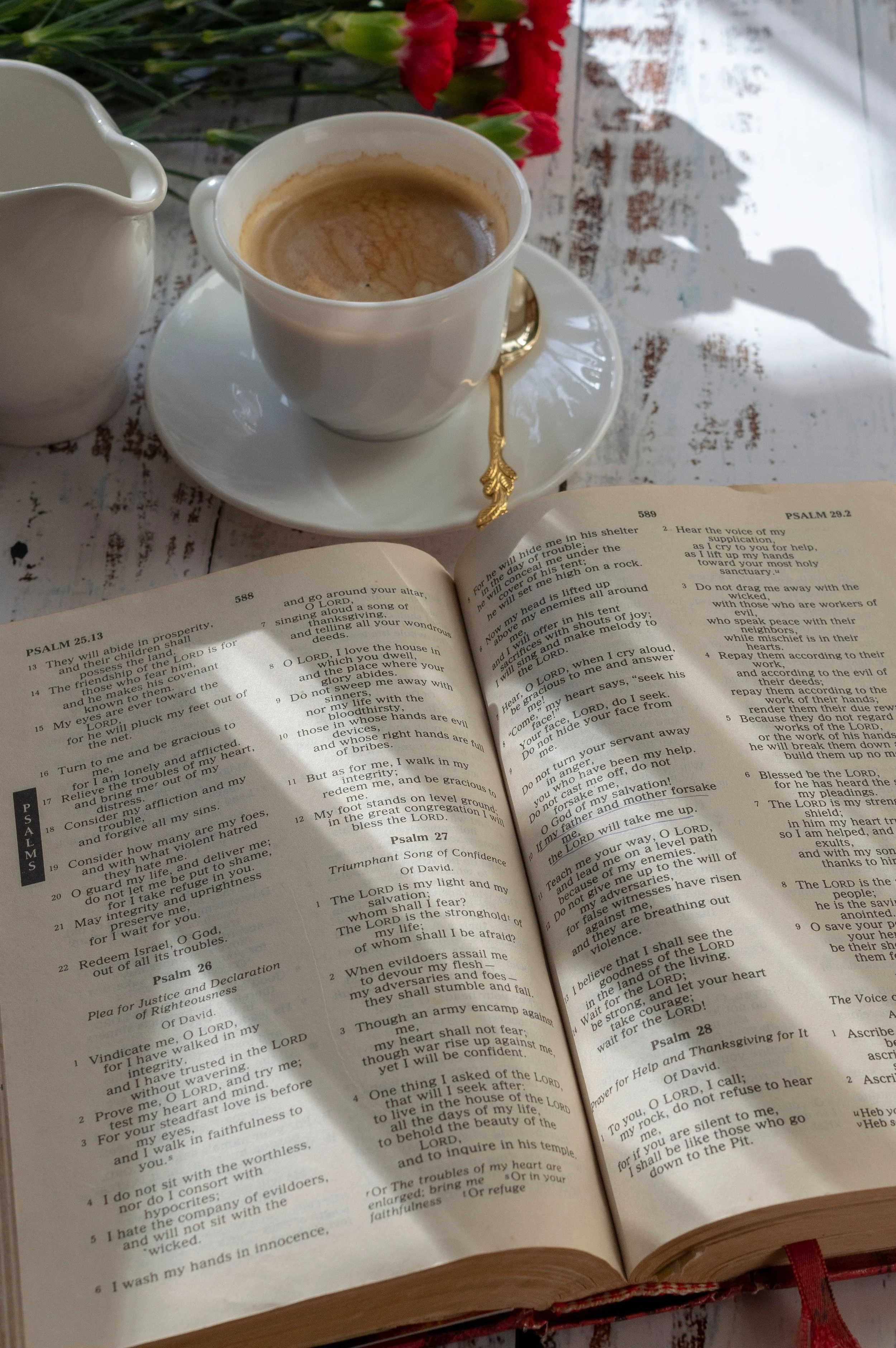
King David — a man described by God Himself as "a man after my own heart" — understood this kind of exhaustion intimately. He writes in Psalm 42:11 (NLT):
"Why am I discouraged? Why is my heart so sad? I will put my hope in God."
What I want you to notice is the sequence of that verse. David doesn't begin with hope. He doesn't manufacture a feeling he doesn't have or paste a smile over the sledgehammer in his chest. He starts with the honest question — the naming of the discouragement, the acknowledgment of the sad heart — and only after that honest naming does he make the pivot toward hope.
That sequence is not an accident. And it is not a lack of faith.
Clinically, this is a process called affect labeling — the act of putting your emotional state into words. Neuroscience research consistently shows that naming what you're feeling reduces the intensity of that feeling. It moves the emotional processing out of the amygdala — the brain's fear center — and engages the prefrontal cortex, the part that can reason, regulate, and reconnect with what's true. You don't think your way out of the feeling first. You name it first. Then the thinking becomes possible.
David was doing affect labeling three thousand years before neuroscience had a name for it.
Lament is not the opposite of faith. It's the front door to it.
The Permission Slip You May Not Have Been Given
I want to say something to you directly that you may not have heard in the spaces where you serve, hold, and show up.
You are allowed to be tired.
You are allowed to sit in the driveway a little longer. You are allowed to come to God exactly as worn out as you actually are — porch light on, dishes waiting, texts unanswered, hands still trembling slightly — not the polished, composed version of you that has everything figured out.
Rest is not weakness. It is not spiritual immaturity. God did not design your nervous system to run indefinitely at maximum output. Even in the creation narrative, rest was built into the structure of existence on purpose — not as a reward at the end, but as a rhythm woven into the fabric of life itself.
You don't have to feel hopeful today. You just have to be honest. And sometimes — as David discovered, as perhaps you're discovering right now, sitting in your car in the dark — that honesty is the first breath of something changing.
A Next Step, If You're Ready
If what you've read here resonates — if you've been carrying the weight of "holding it together" and you're tired in ways that one good night of sleep can't fix — I want to invite you into a space that was built specifically for people like you.
The HolyPsych Sanctuary is a private online community where clinical psychology and Christian faith work together, not against each other. It's a place where you can stop performing and start healing — where the fog is named, not shamed, and where the pace of grace replaces the pressure to perform.
Inside the Sanctuary, you'll find:
A full course library that walks through the biology of anxiety and depression alongside the theology of suffering and hope
Weekly Spring Renewal videos and community posts to keep your mind anchored and your heart connected
A community of people who understand what it means to be weary in ways that the world — and sometimes the church — doesn't quite have language for
Clinical tools grounded in CBT, somatic therapy, and behavioral activation, woven together with scripture and prayer
This is not a place to have it all together. This is a place to come as you are — tired, foggy, honest — and find that you are not alone in it.
The porch light is on. Take your time. We'll be here when you're ready to walk in.
David Lombard, PhD, is a psychologist and the founder of The HolyPsych Sanctuary, an online community integrating clinical psychology with Christian faith. He works with individuals navigating depression, anxiety, and the unique struggles of faith-based mental health. Learn more at HolyPsych.